
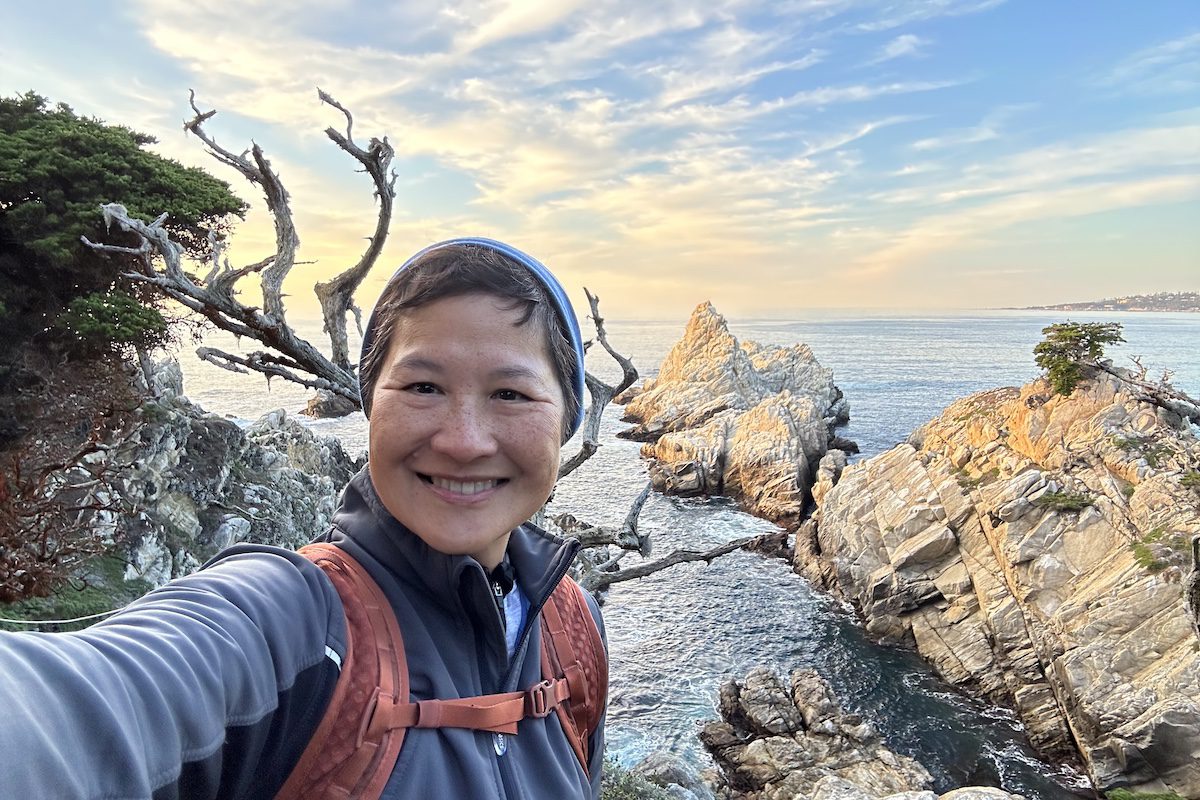
How women make travel an uplifting experience
by Norie Quintos
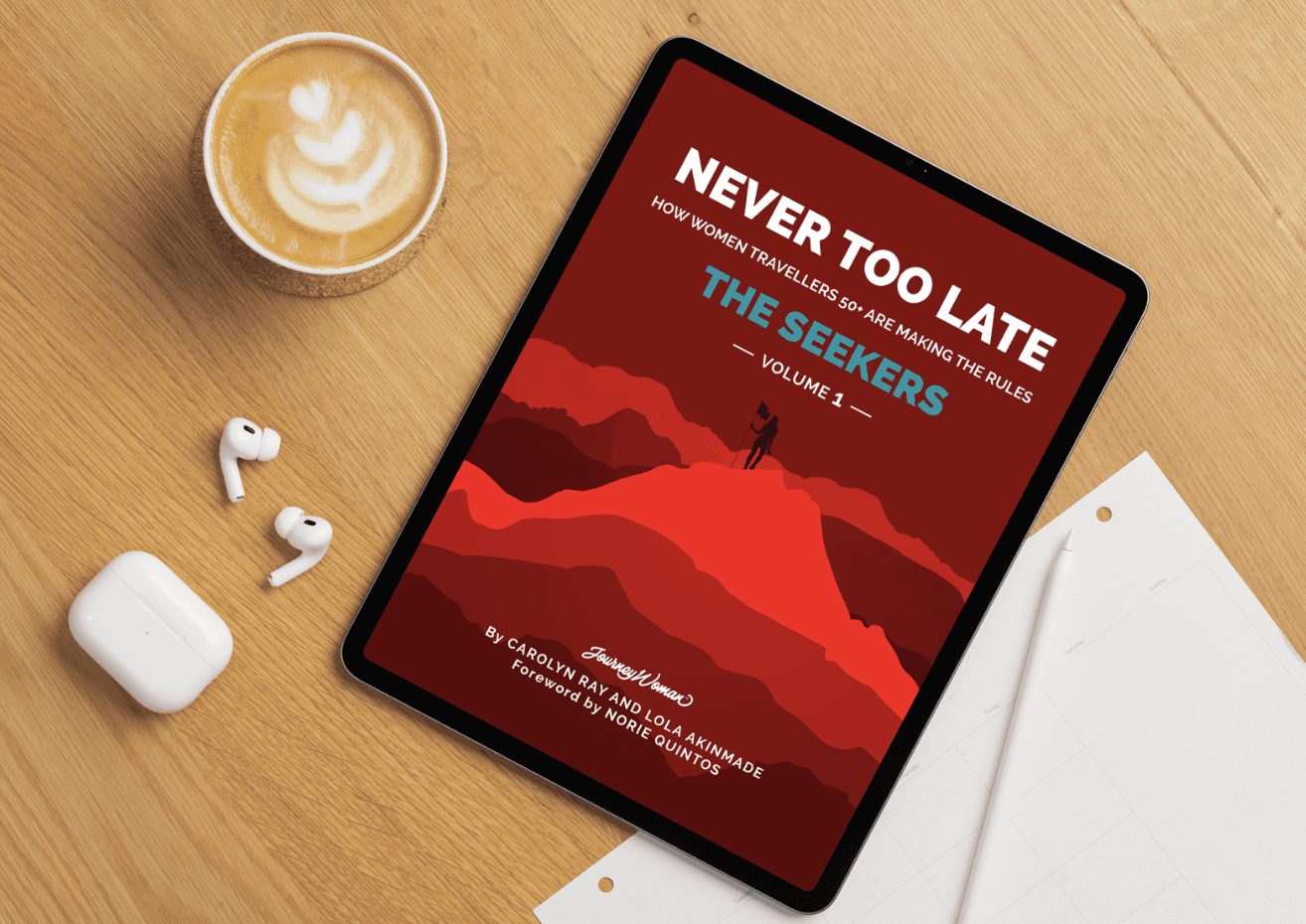
(Reprinted from the Introduction of “Never Too Late: How Women 50+ Are Making the Rules” published by JourneyWoman in 2025.)
In Quito, Ecuador, I got my hair cut by a self-described bruja (witch), who took a ring made of leather and rabbit fur from her finger and gave it to me to wear for good luck….
At a remote camp in Australia’s Northern Territory, the pilot of the bush plane, seeing as I was not in a hurry, asked me to help him push the tiny two-seater out of the sun and into the shade….
In Kansas City, I somehow found myself on the site of a 19th-century Shawnee prophet’s home translating fortunes for a Spanish-speaking medium….
While visiting my sister in Seattle, a Canadian friend suggested I take the ferry over to Victoria for the weekend; we hiked the windswept Saanichton coast, accompanied by her Bernese Mountain dogs….
On the plane back to my home airport in Washington, D.C., the woman seated next to me told me she took up travelling after the untimely death of her blind son. “He couldn’t see the world, so I’m doing it in his honour.”
For women venturing on their own—even if they are in the company of others— these kinds of non-scripted experiences are what make travel an uplifting experience.
Show your support for our editorial and advocacy for women over 50. Join our mailing list here.
Where are all the men?
As a longtime travel editor, writer, and communications consultant focused on sustainability, I’m especially lucky to have had work that takes me places and a flexibility that allows me to extend stays and explore local communities in more depth.
But you don’t need a particular job or an especially adventurous personality.
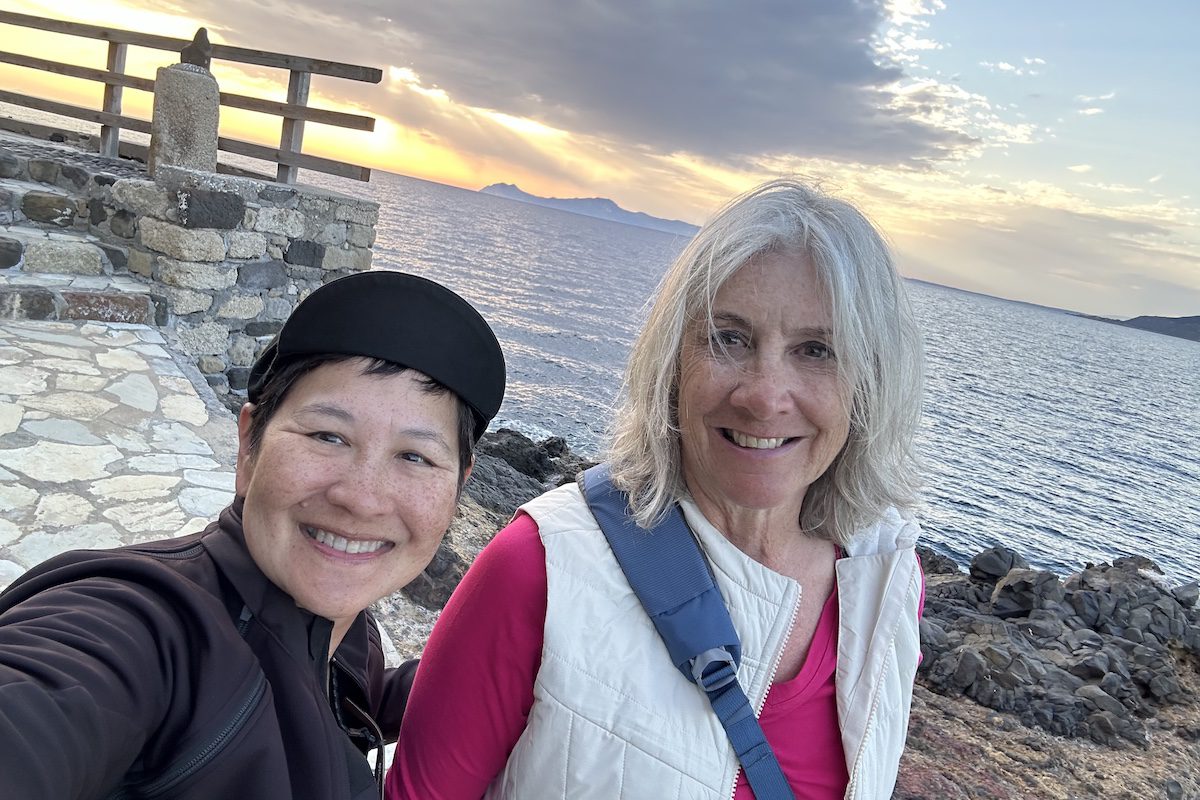
On my most recent trip, a month-long group cycling holiday in Turkey and Greece loosely following in the footsteps of Homer’s Odyssey, participants consisted of seven couples and seven solo travellers. Of the solos, all were over 50.
And all but one were women. One of my fellow travellers, Moyra Deans, of Ottawa, Canada, explained that her husband wasn’t a cyclist and it was difficult to match schedules and budgets with her cycling friends.
“Even if we could make it work, I would feel responsible for their enjoyment,” she says. “I sign up solo, and just ‘find’ new friends, who often end up becoming old friends.”
I’m now one of her new friends. I, too, have found fellowship, and made friends, both women and men, by embarking on my own. Everywhere I go, I meet fellow women travellers—so many that I’ve wondered where the men are and what they are doing. It’s not just my imagination. Women, it turns out, make up a whopping two-thirds of all travellers and make 96 per cent of travel decisions, according to JourneyWoman’s latest research. While the media is full of images of young solo nomads, here’s the reality: The average traveller (in the U.S.) is a 47-year-old woman. Many are married but travelling without their spouse.
Older women have trillions of dollars in purchasing power. Women are also living longer and healthier lives. The popular but rigorous Camino de Santiago pilgrimage route across northern Spain bears this out. Statistics show that six per cent more women than men undertake it. At least 50 per cent of pilgrims are older than 46, and 10 per cent are more than 70 years old.
A study by the tour operator Road Scholar found that at least 60 per cent of the company’s travellers were married but travelling without their spouse. They are women like 94-year-old Violette Yacoubian of Maryland, U.S., who took up travelling at 70 after her husband died. Or Susan Mol of New South Wales, Australia, who has travelled in search of her family’s roots in Italy and met distant cousins. Or Marybeth Bond of California, U.S., who has written 11 books on women’s travel, as well as the inspiring women you will find within the pages of this important book.
They are women like you.
Travel isn’t the problem
For me, travel and places have helped solve every problem I’ve had in life. The act of removing myself temporarily from my normal environment has allowed me to momentarily distance myself from a particular issue, helped me assess it with new eyes, and given me space to generate creative solutions, or at the very least, a more accepting attitude.
In Kenya, a Maasai elder once suggested I simply “go for a silent walk together” with my son if he was upset. I was astounded to find out how well it works. What a lifeline it was for a single mother with two kids.
When I first began my career in travel media in the 1990s, we were just becoming aware of the impacts of climate change and the role of the travel industry, particularly aviation, in contributing to the problem. National Geographic, the magazine I worked for, and still write for, wrote early on about the looming crisis and the people in the forefront of a new kind of sustainable travel.
Now the impacts have become undeniably clear: Without drastic and collective action, we will continue to see cascading impacts such as rising seas, more destructive weather events that threaten lives and food supplies, and political and social instability. The future of humanity is at stake.
Travel—which bridges people across cultures, promotes creativity and problem-solving, and connects us to nature and our highest selves— isn’t the problem. The solutions exist today, and women are at the forefront.
Women travellers can lead the way
According to Anna Pollock of New Alresford, UK, a JourneyWoman Award recipient featured in this book, the answer lies in transforming travel from a commodity back to its regenerative roots as a cultural exchange between host and guest in a unique setting.
I envision experienced women travellers leading the way. We can travel in a way that does not harm Mother Earth right now. Many are doing so. They’re travelling lightly, curiously, less frequently but for longer periods, kicking the travel bucket list and replacing it with richer experiences that put money in the local economy, not in the pockets of multinational corporations.
When people say they love to travel, they typically don’t mean being in planes or waiting in airports. What they love is being in places with unique cultures or bountiful nature. This is the reason I don’t keep track of how many countries I’ve been to. It turns what should be a thoughtfully considered act of curiosity into a game of acquisition that rewards speed and wasteful use of carbon emissions.
“Our world follows the wrong stars. We live in a world bloated with information yet starved for wisdom. The point at which the latitude of the mind meets the longitude of the heart is the center. It’s the place of deeper knowing. There are women wedded to the natural world who have this wisdom so refined it is missed by the loudness of modern society. These are the women who, like constellations, guide me.” — Elizabeth Kapu’uwailani Lindsey
As women, we are protectors of place
As women travellers, we must appreciate and support the stewards of the lands we visit.
I’ve met and interviewed many women tending to their corners of the globe and in so doing restoring the planet. Some of the strongest protectors of place are women who aren’t travellers in the typical sense.
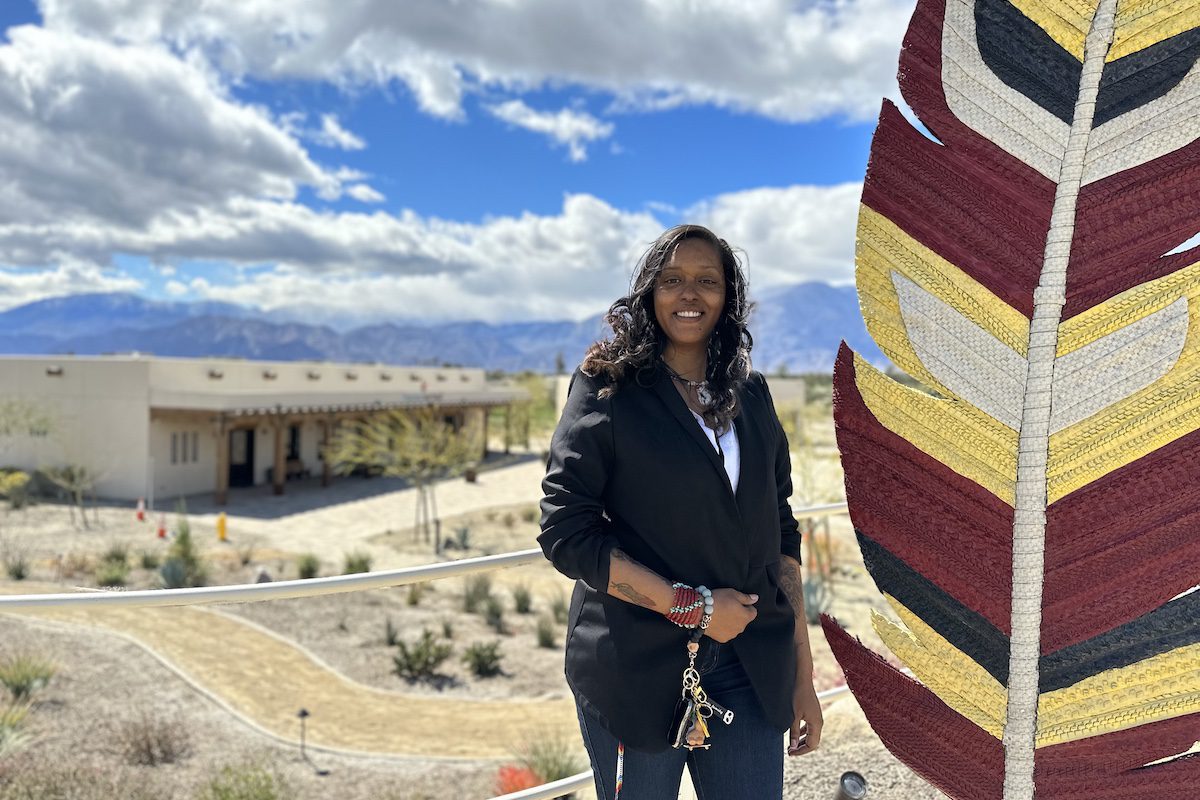
They’re women like Amanda Augustine, tribal leader of the Augustine band of Cahuilla Indians in California’s Coachella Valley, who fulfilled her mother’s dream of starting a farm, Temalpakh, (with a farm store open to visitors) that ensures food security for not only the tribe but for the wider community.
Or Poonam Rawat-Hahne, who trains young widows and victims of domestic violence to become tour guides and artisans and homestay hosts in the Himalayas of India, through the organization she founded, Fernweh Fair Travel.
Or Priscilla Macy, of Cape Town, South Africa, who crafts responsible African safaris through her company Global Sojourns. She set up a foundation that supports the education of women and girls through local partners who understand the complex obstacles best.
I’m inspired by my friend Elizabeth Kapu’uwailani Lindsey, a cultural anthropologist and National Geographic Explorer. She often speaks of the tradition among Indigenous cultures of “wayfinding,” which uses seemingly unrelated bits of data and intuitive intelligence to navigate a course. We can each be the stars that guide the women and men that come after us. So, travel intentionally and slowly, giving back more than you take. Take the time to find and support the stewards of place.
And return home changed and charged and reconnected to that place of places, our home planet.
Norie Quintos is an independent journalist and editor. She is a contributing writer to National Geographic and the former executive editor of National Geographic Traveler. She is also a consultant for the travel industry, advising destinations and travel companies on how to tell their unique stories. Her work focuses on sustainable, Indigenous, regenerative, transformational, and responsible travel. She believes in the power of travel to be a force for good and is on the board of the Adventure Travel Conservation Fund. Learn more at https://www.noriequintos.com/

0 Comments