

Last updated on March 13th, 2026
Featured image: Even with all the disruption in our world, there are many places to travel safely and well | Photo by lucigerma on Envato
Safety tips, travel insurance and where to travel safely
by JourneyWoman
There seems to be no end to the chaotic forces disrupting travel right now. Whether it’s the recent capture of Venezuelan President Nicolas Maduro, escalating tensions in Iran, or the U.S. embargo to Cuba, choosing a destination feels more complex than ever. Then there’s the increasing cost of fuel, largely driven by the U.S. Administration’s war with Iran, which could result in billions of extra costs for airlines, which will be passed on to the consumer.
But we live in a big world, with many places to travel that are affordable, safe and welcoming to women. Regardless of your chosen destination, we’ve created a checklist for safe travel to help women plan for uncertain times.
Staying safe in uncertain times
Whether war, an earthquake, or other natural disaster, there are some things we can do to stay safe before any travel, particularly in affected regions.
1. Check government safety advisories and register with your government for travel before you leave
Check government safety advice before you plan travel and look at a map to understand borders and conflicts. Government agencies have subscription services that provide travellers with information during times of unrest. Check your government site before you leave to understand or subscribe to email or SMS alerts. Consider using an eSIM (an electronic SIM) on your phone to stay connected where there is cellular service.
Canada: Canadians Abroad is a free service that allows the Government of Canada to notify you in case of an emergency abroad or a personal emergency at home. The service also enables you to receive important information before or during a natural disaster or civil unrest.
United States: Enroll in STEP (Smart Traveler Enrollment Program) which is run by the US Department of State – Bureau of Consular Affairs. STEP is a free service to allow U.S. citizens and nationals traveling and living abroad to enroll their trip with the nearest U.S. Embassy or Consulate.
New Zealand: The Ministry of Foreign Affairs and Trade, including New Zealand Embassies, High Commissions and Consulates-General around the world, use the SafeTravel registration system, which provides information to registrants in an emergency (e.g. natural disaster, terrorist attack, civil unrest)
United Kingdom: While the UK doesn’t have a registration system, you can search Foreign Travel Advice on the government’s website.
Australia: Smartraveller is a government subscription service that provides travel advice updates by email and SMS critical alerts.
2. Buy comprehensive travel insurance
Make sure you have comprehensive travel insurance and that it covers trip and cancellation changes. However, most do not definitively cover war. Decisions are made on a case-by-case basis.
We recommend travel insurance, particularly for complex, out-of-country trips. There are many options available in the US and Canada. To compare prices, check insuremytrip.com. Other options include Wanderwell, a B Corp that donates 1% of its profits to environmental causes and TuGo. Read the policies and call and ask questions.
“I always encourage travellers to purchase Medical Insurance and Trip Cancellation/Interruption Insurance as there is so much that is covered,” says Cathy Gotfried, CEO, Erawan Travel/ Babes in Bali. “However, it’s really important to read the fine print on each policy. Over the years there have definitely been more added to ‘what’s not covered’ over what is covered.”

Recommended Travel Insurance
InsureMyTrip: InsureMyTrip helps travelers like you easily compare top plans and providers to find the right travel insurance for your unique trip. Learn more here.
TuGo: TuGo is a Canadian-owned and operated travel insurance provider with a focus on the health, safety and well-being of its travellers in Canada and around the world. Learn more here.
World Nomads: Designed by travelers for travelers, to cover trip essentials. Even if you run out of travel insurance or leave without it, World Nomads can cover you. Learn more here.
SafetyWing: Insurance for nomads. Travel medical insurance. World Nomads covers people from all over the world, while outside their home country. Learn more here.

3. Check your passport expiry date, and keep your passport with you
Most countries require at least six months validity on a passport. Before you travel, make sure you are aware whether you need certain vaccines or a visa to enter countries, as regulations are constantly changing. If you do need a visa, use the official government sites as there are many scammy sites. Should the unexpected happen, keep your passport with you so that you can move easily should an emergency arise. Use a cross-body bag or a money belt. Never put your passport in your checked luggage.
4. Pack lightly
Not only is it more affordable to not check a bag (especially on budget airlines), packing lightly allows you to adapt to faster, without worrying about where your luggage is. Even though budget airlines offer affordable fares at the outset, the cost of checking a bag can be more than the ticket. In some cases, train travel can be a better option. Don’t bring valuables with you, particularly flashy jewelry.
5. Avoid routes that go through the Middle East
If you book your own flights directly or on Skyscanner or Expedia, it’s important to check the flight routes. Many of them route through Middle East hubs but there are always options through Europe. Make sure you have downloaded your airline’s app which is often used as a communications channel.
6. Use a travel advisor
Travel advisors often have information that we don’t. Travel advisors receive hundreds of alerts every day from travel and tourism organizations from around the world, and relationships with on-the-ground travel suppliers around the world. They can also recommend options that we might not have thought of.
7. Going on a tour or cruise?
If you are going on a tour or cruise, confirm with your tour company that they have a plan B should the situation escalate. Are they in touch with the tourism boards? Do they have a travel alerts page, like Intrepid Travel Alerts?
8. Plan for cybersecurity risks
Scams can happen to any traveller, but when women are travelling solo, we tend to rely on public wifi, the Internet and our phones more than usual. Unless we’re ready and prepared, we may be unknowingly giving thieves and hackers access to our personal data and identity. Read our cybersecurity tips here, and consider taking our cybersecurity course here.
Read More: Six Reasons to use a Travel Advisor
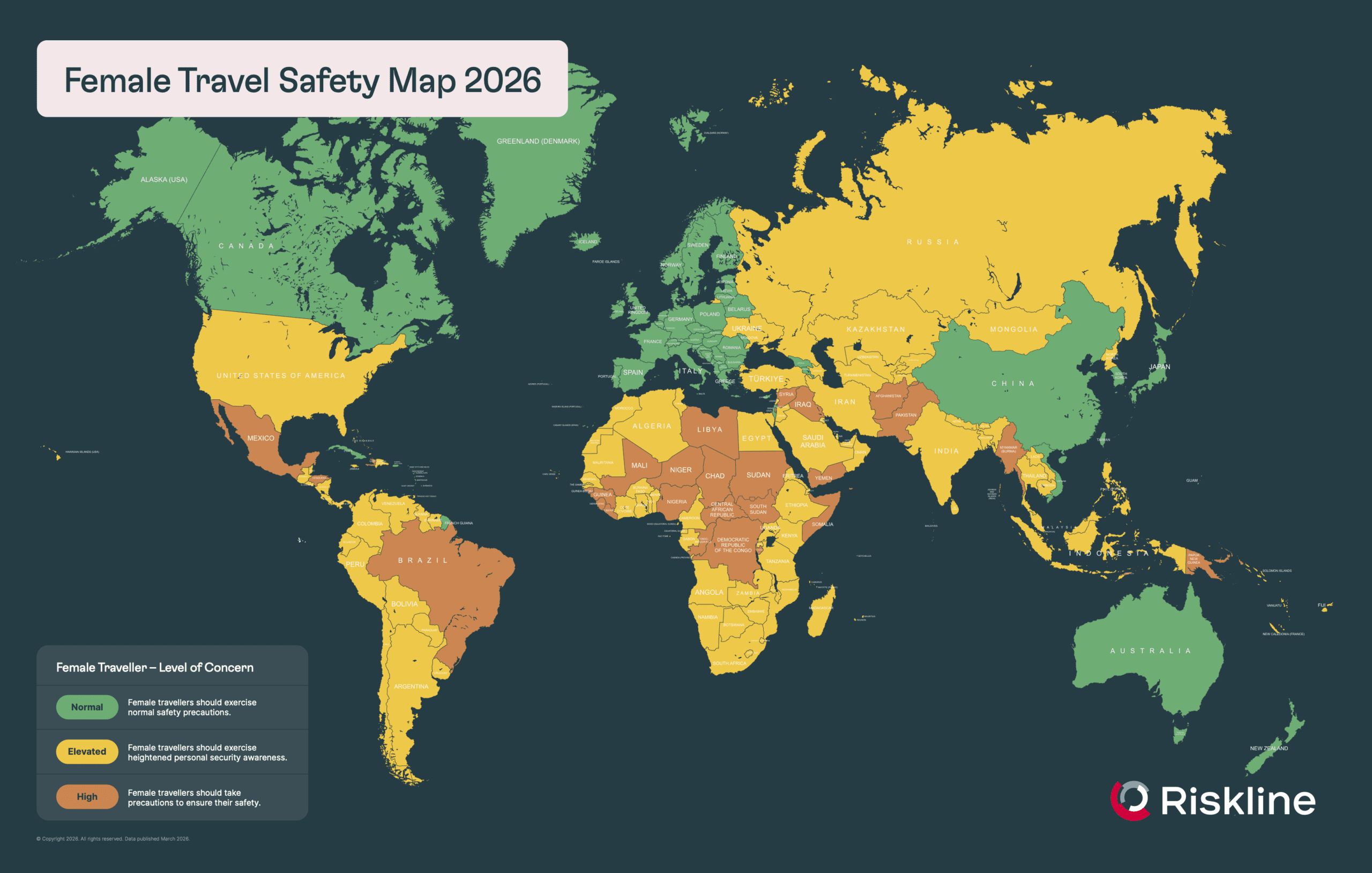
Female traveller safety as of March 9, 2026/ Credit Riskline
Riskline’s Female Traveller Safety Map
According to Riskline, a specialized travel risk intelligence provider based in Denmark, 29 countries are identified as “high concern” for female travellers, indicating that extra precautions are recommended to ensure their safety. The countries are listed below by region:
- Americas: Brazil, Mexico, Haiti, Honduras
- Asia-Pacific: Afghanistan, Myanmar, Papua New Guinea, Pakistan, East Timor
- Sub-Saharan Africa: Burundi, Central African Republic, Congo-Brazzaville, Democratic Republic of Congo, Guinea, Guinea-Bissau, Liberia, Nigeria, Sierra Leone
- Middle East and North Africa: Chad, Iraq, Mali, Niger, Syria, Somalia, South Sudan, Sudan, Libya, Yemen, West Bank and Gaza
In contrast, safer destinations for female travellers continue to include countries in Europe, as well as Canada, Japan, New Zealand, Singapore, China, South Korea and Australia.
If you want to travel overseas this year, some options
United Kingdom, Wales and Ireland: If the completion of the 2,795-mile King Charles III England Coast Path and the 100th birthday of Winnie the Pooh aren’t enough to inspire travel to the UK, there is also Wales and Northern Ireland. For movie buffs, there are UK filming locations for Bridgerton and the Game of Thrones, among others.
Get inspired with our Women’s Guide to the UK here.
Find tours to the UK in our Women’s Travel Directory here.
Europe: Europe is still one of the safest places to visit, whether it’s to gardens in France, train journeys in Switzerland or visiting small towns in southern Spain. Malta has been a hot topic on our Facebook group with many solo women choosing to go there this year. The European Christmas Markets open in mid-November, offering options in Prague, Vienna, Budapest and Germany, among other countries.
Get inspired about Europe in our Women’s Guide to Europe here.
Find and book tours to Europe in our Women’s Travel Directory here.

Get inspired about Africa in our Women’s Guide to Africa here.
Find tours to Africa in our Women’s Travel Directory here.
Morocco: Whether you dream of spending a night in the Sahara Desert, visiting Morocco’s many UNESCO World Heritage sites, or discovering Roman ruins like Volubilis, Morocco is one of the more affordable destinations. From guided tours to mother-daughter trips, Morocco offers a deep cultural experience that calls you back again and again.
Read more on Morocco in our Women’s Guide to Africa here.
Find tours to Morocco in our Women’s Travel Directory here.
Asia-Pacific: Japan, South Korea, Malaysia, Thailand and Vietnam are among some of the most welcoming, affordable and safest places for women. Fly through western Canada or North America to avoid stops in the Middle East.
Read more on Asia in our Women’s Guide to Asia here.
Find tours to Asia in our Women’s Travel Directory here.
Staying closer to home
For those in North America who don’t want to travel overseas, there’s lots to see in our own backyards.
Canada: Canada is the perfect year-round destination, whether you want to hike the PEI Camino or head to Western Canada. It’s affordable, welcoming to all visitors and has places like Quebec City, that feel just like Europe.
Get travel inspiration for Canada in our Women’s Guide to Canada here.
Find tours to Canada in our Women’s Travel Directory here.
Mexico: With direct flights and its proximity to the US and Canada, Mexico comes recommended for long stays in safe destinations like Merida, Oaxaca, and San Miguel de Allende, to name a few.
Get travel inspiration for Mexico in our Women’s Guide to Mexico here.
Find tours to Mexico in our Women’s Travel Directory here.
Central America: Smaller Latin American countries like Costa Rica, Panama, and Nicaragua are great beach and adventure destinations for women. It’s also turtle nesting season this summer, adding even more appeal for nature lovers.
Get travel inspiration for Central America in our Women’s Guide to Mexico here.
Find tours to Central America in our Women’s Travel Directory here.
South America: The fourth largest of the world’s continents, there are women-friendly options to consider in Medellin, Colombia, or the Andes Mountains or Amazon region in Ecuador.
Read more on South America in our Women’s Guide to South America here.
Find tours to South America in our Women’s Travel Directory here.

Discover Less-Traveled Destinations Around the World

Five Countries That Welcome Solo Women Travellers and Why You Should Visit
Women continue to drive tourism decisions globally, and are choosing destinations that offer safety, authenticity, cultural depth and purpose

Stepping into the Clouds in Langkawi Island, Malaysia: What’s Not to Love About the Andaman Sea, White Sand Beaches and UNESCO Geoparks
If stepping into the clouds is an adventure you enjoy, Langkawi, an archipelago of islands in Malaysia, may be just the place for you.

Taking It Slow: Island-Hopping in Croatia
With about 1,200 islands, Croatia’s Adriatic coast has its own story, history, personality and rhythm. Which one will you choose?

0 Comments